Description
Photograph
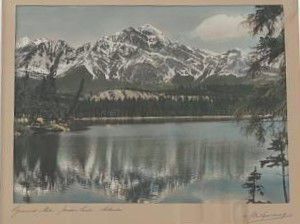
This hand-tinted black and white photograph shows Pyramid Mountain, aptly named for its shape, situated in Jasper National Park in Alberta. Sir James Hector named the mountain in 1859 due to its appearance from the Athabasca River valley on the eastern side of the peak. Spanning over 11,000 square km, Jasper is the largest national park in the Canadian Rockies. Declared a UNESCO World Heritage Site in 1984, the Park is known for its vast wilderness, majestic peaks, abundant wildlife and outstanding natural beauty.Context
Sir James Hector KCMG FRS FRSE (1834-1907) was a Scottish-New Zealand geologist, naturalist, and surgeon who accompanied the Palliser Expedition, known officially as the British North American Exploring Expedition, that investigated the geography, climate and ecology of what would later become western Canada, 1857-60. Of note, at one point Hector was kicked in the chest by his horse; however, his premature burial was cancelled when he regained consciousness. The B.C.-Alberta border pass and nearby river have been known since as Kicking Horse Pass and Kicking Horse River.
_________________
Jasper National Park comprises mountains, valleys, glaciers, forests, alpine meadows, and rivers along the eastern slopes of the Rockies in western Alberta. It includes close to 1,000 km of hiking trails. There are backcountry campsites, lodges, horse outfitters, and hiking/interpretive guides. The Alpine Club of Canada also manages four alpine huts.
Established in 1907, Jasper protects wildlife that was once commonplace in the West. Strong populations of plants and animals persevere in the park where its elevation, geology, geography, and climate serve as a safe habitat for a variety of species, including nearly 70 species of mammals such as elk, moose and grizzly bears. Jasper is part of the UNESCO Canadian Rocky Mountain Parks World Heritage Site, one of 15 World Heritage sites in Canada.