Description
Sculpture
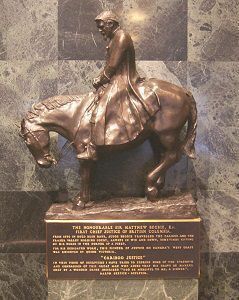
This mounted figure depicts Sir Matthew Baillie Begbie (1819-1894), a British lawyer, politician, and judge. A weary Begbie is shown in wig and long gown on horseback as if moving down a steep mountain trail (indicated by the sloped base), imagined on his way to (or from) administer justice at a remote site in the B.C. Interior. The horse also appears weary, his head down and the reins are slack as he proceeds downward.
In 1858, Begbie became the first Chief Justice of the new Crown Colony of British Columbia in colonial times and in the first decades after British Columbia joined Confederation as a province of Canada serving from 1871 until his death in 1894.Type of Sculpture
Free StandingContext
Likely born on a British ship at the Cape of Good Hope, Begbie first lived in Mauritius, and later in Guernsey. Following studies at Elizabeth College, Trinity College - Cambridge, and later Peterhouse College he obtained a BA in 1841. After articling, Begbie became a barrister three years later. In 1858 his name was put forward for the position of judge of the new colony of B.C.
With the influx of over 30,000 prospectors and others during the Fraser Canyon Gold Rush from 1858 and the later Cariboo Gold Rush of 1861, Begbie played a crucial role in establishing law and order in the B.C. Interior and the mining camps. His efforts and those of Governor James Douglas ensured that the colony remained British, to later become part of Canada. Begbie traveled throughout the province, on foot and later on horseback and by canoe administering justice. In 1865 alone, he reportedly covered some 5,600 kilometres. Begbie also played a valuable role as a member of the colonial executive and as the originator and draftsman of important legislation.
Begbie was viewed as contentious, yet he also had a lifelong interest in progressive law reforms, he made sound civil litigation decisions, he persuaded the federal government to preserve traditional Indigenous fishing rights on the lower Fraser River, and he expressed a positive opinion of B.C.'s First Nations and Chinese peoples. He was also seen as controversial for his racial attitudes at times, for accusations of judicial impropriety, for his denunciations of juries who reached verdicts he did not like, and in particular, for his role in the trials of six Tsilhqot’in Chiefs which resulted in their execution. The six were exonerated posthumously
in 2014.
After his death, this man of many contradictions with a controversial legacy, came to be known as the 'Hanging Judge', although many dispute this conclusion. Begbie was made a Knight Bachelor according to the London Gazette of November 19, 1875.