Description
Painting
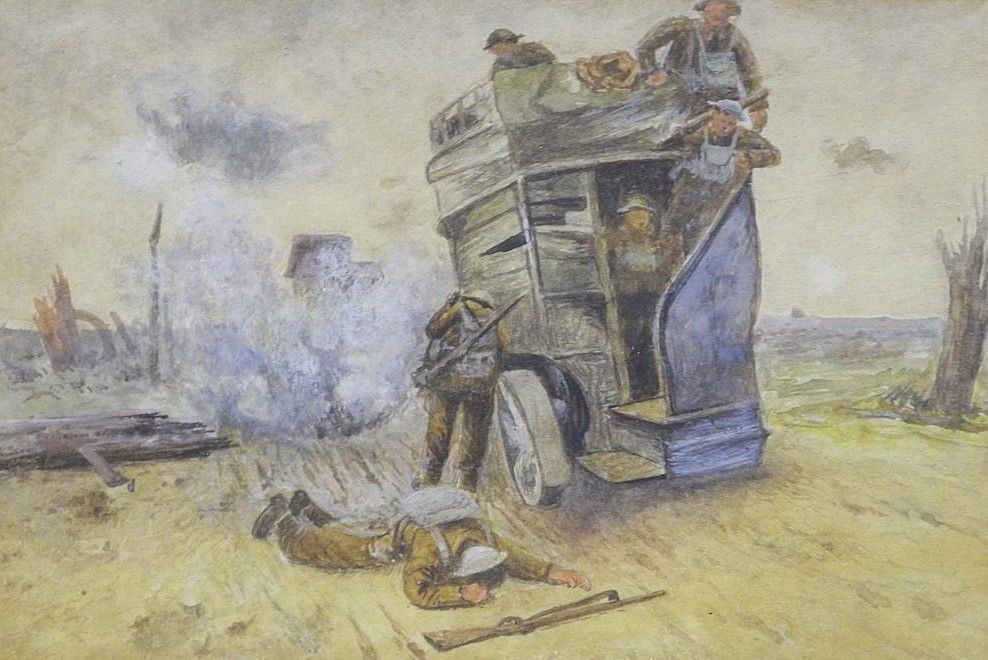
This image depicts a World War I battle scene in France with a drab shell-blasted landscape of devastation. The focus of the image is the rear of an "armoured" B-Bus or battle bus with British-Commonwealth soldiers in their soup bowl helmets, escaping down the external rear stairs to the ground. The pale face of one soldier in the doorway draws the viewer into the scene.
It appears that an artillery round has just exploded on or in front of the vehicle. Billowing smoke obscures the frontal view, and a wounded/dead soldier is lying face-down on the ground at the rear with his rifle beyond his outstretched arms. The painting is small in size and the artist has captured one moment in time from The Great War, perhaps a blend of personal and adopted experience. The exact location is unknown and the soldiers are unidentified.Context
The First World War was the first truly global-scale conflict initiated after the assassination of Archduke Franz Ferdinand of Austria. From 1914 to 1918, fighting took place in different theatres across multiple continents on land, at sea and in the air. The combat was grueling, destruction was unprecedented and the number of deaths staggering – the combined worldwide military/civilian death toll was estimated at 24 million with many more wounded. Some 66,000 Canadians and Newfoundlanders sacrificed their lives, with some 172,000 wounded.
During the war, the Triple Entente Powers alliance (or Allies), led by France, Russia, the British Empire including Canada and later Italy (1915 on) and the U.S. (1917 on) defeated the Central Powers, led by the German, Austro-Hungarian, Bulgarian and Ottoman Empires. As the war progressed, each alliance gained and lost members. Russia withdrew from the war after its revolution, 1917-1922.
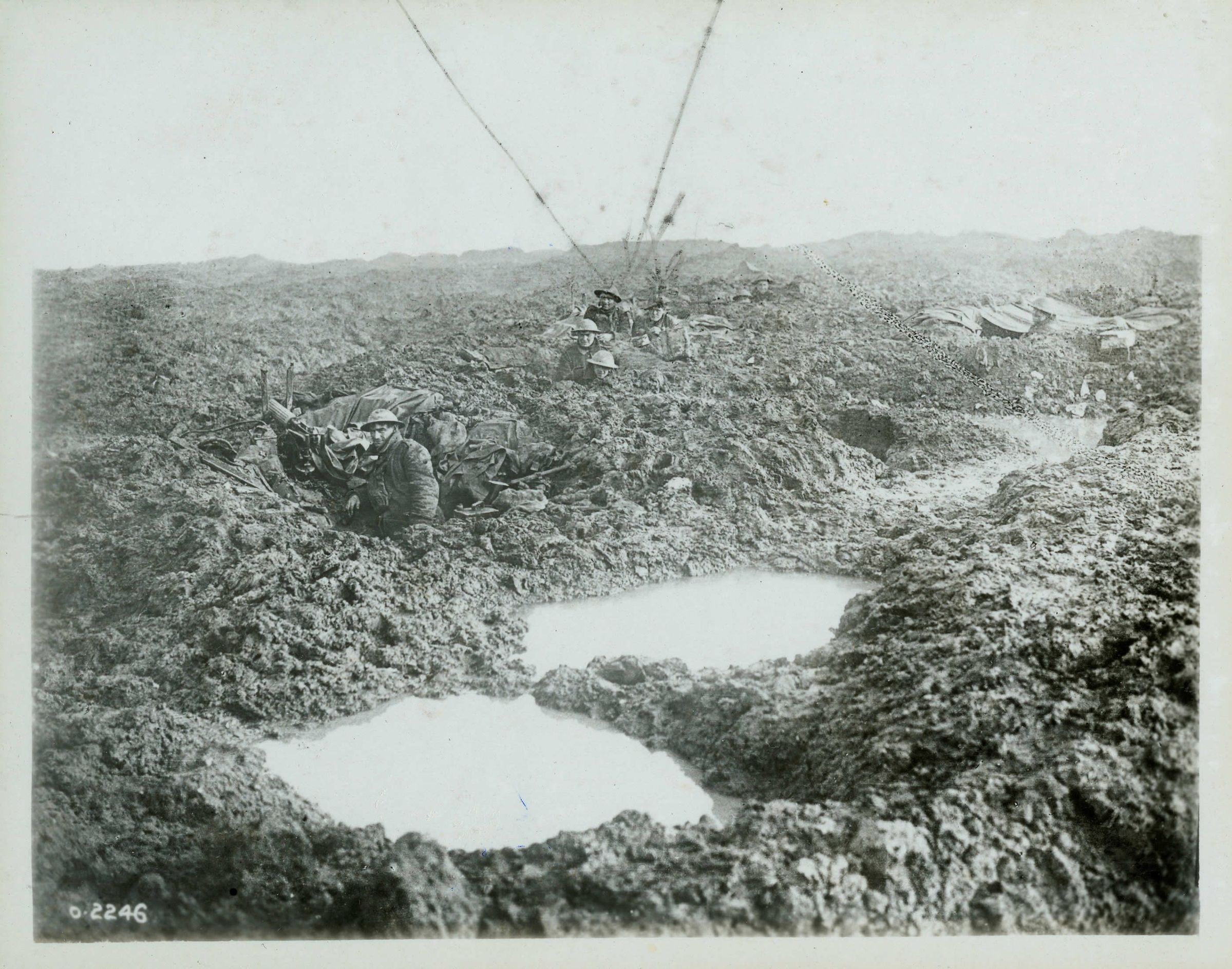
On the battlefields of northern Europe, the British Empire fought the enemy and the elements along a system of trenches that stretched over 600 km from the North Sea to the Swiss frontier with France. Known as the Western Front, the battle here "transformed the landscape of northern France and Belgium into a lunar mud-scape of shell craters, corpses, abandoned equipment and wire entanglements."* For most of the war, this front was locked in a brutal stalemate, where both sides tried new tactics and technologies including poison gas, flame throwers and tanks. However, an Allied breakthrough finally defeated the Germans in 1918 with terms of peace settled by the Treaty of Versailles in 1919.
Ultimately, this war brought an end to a mostly stable world order that had dominated since the end of the Napoleonic Wars in the early 1800s. Four empires collapsed (Austro-Hungarian, German, Ottoman and Russian) and the aftermath led to the later outbreak of the Second World War (1939-45).
* See Web Links - U.K. National Army Museum
__________________________
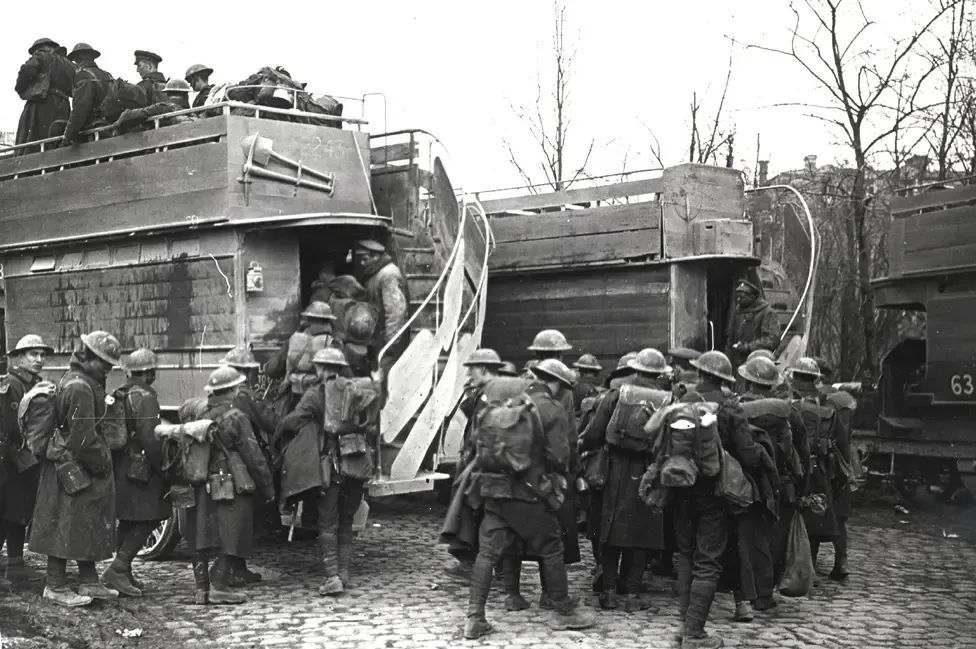
B-buses or battle buses were London buses that were commandeered for the war effort and used to transport troops to and in France and Belgium and beyond in World War One. The majority of the buses were refitted to transport soldiers and others were converted for a variety of purposes such as ambulances, pigeon lofts, engineering workshops and even touring cinemas. Civilian bus staff, both drivers and mechanics, were often commandeered along with their vehicles. Some 1,000 London buses were requisitioned for war service, about one third of the London fleet at the time.
* See Web Links - BBC
________________________
Of note, metal helmets started to appear in early 1915 with the recognition that better head protection was needed to help reduce the number of head wounds due to shrapnel and shell fragments. The French were the first to develop a solution – steel skull caps to be worn underneath their military caps, soon replaced by the Adrian Helmet Model 1915. The British first produced their steel Brodie Helmets in early 1915, designed by John Leopold Brodie. The helmets were first issued to British troops in September 1915 at the rate of 50 per battalion. One million Brodie helmets were distributed in the summer of 1916. It was the first helmet given to all serving soldiers in the British and Commonwealth armies, regardless of rank.