Description
Painting
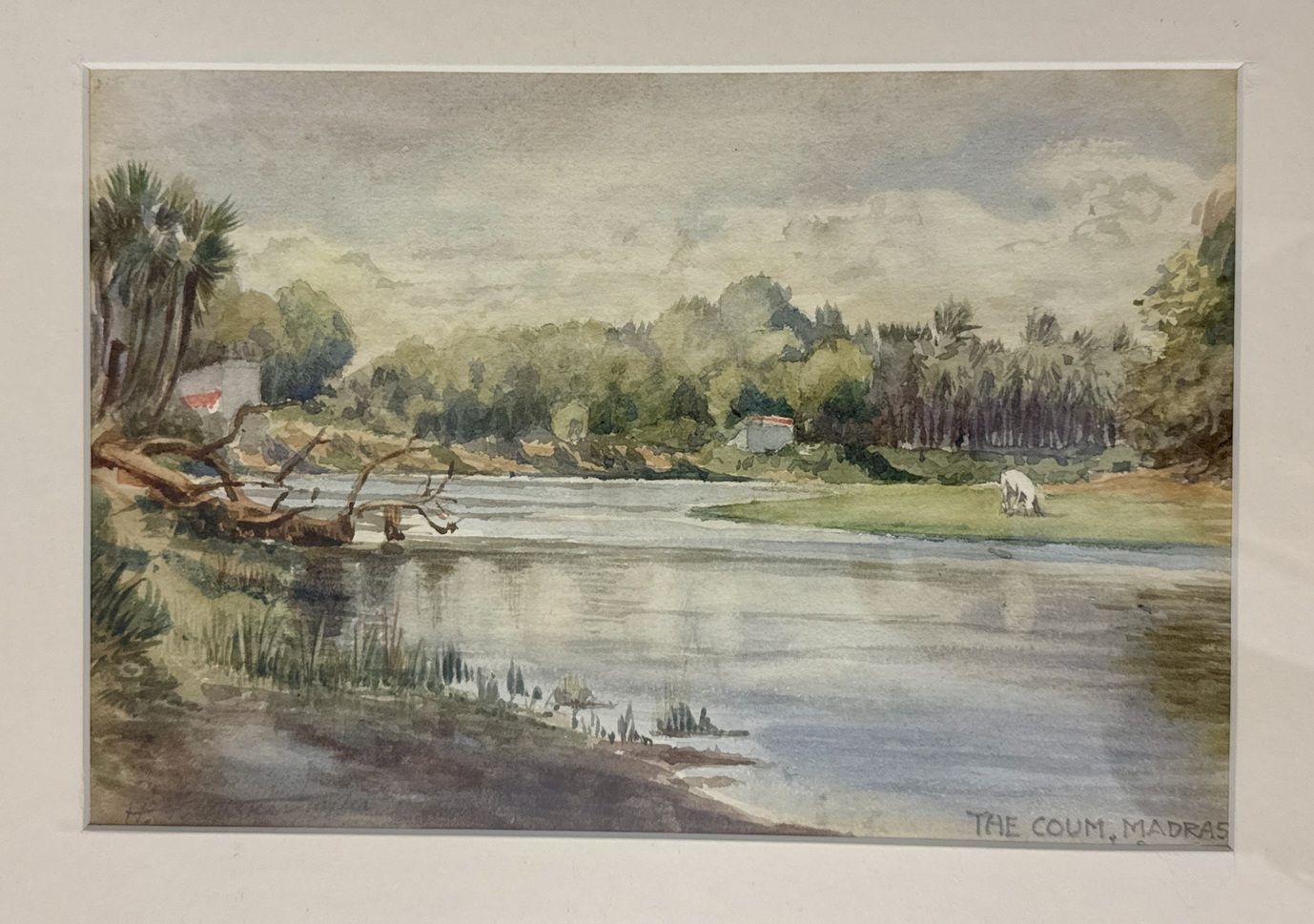
This landscape image depicts the Coum River in Madras, now known as Chennai, in southern India. The vista reflects the long tradition of British watercolour landscape art - a gentle and softly painted view leading the eye from a foreground shoreline across the curve of the river to a farmer in white bending in a grassy field across to the background shoreline with a forest of tall trees and buildings in partial view. It is a representation that balances scenic accuracy at the time with artistic expression.Context
Madras, known as Chennai since 1996, is the capital and largest city of Tamil Nadu, the southernmost state of India and is located on the Bay of Bengal. Two major rivers flow through Chennai, the Coum (or Cooum or Koovam) River through the city centre and the Adyar River to the south. The Coum travels a distance of some 20 km within city limits. The 2025 estimated population of Chennai is 6.8 million, while the Chennai metro population is estimated at 12.6 million.
This city has been ruled and occupied by many different tribes, invaders and cultures since ancient times, and it was an important administrative, military, and economic centre for many centuries. After the Portuguese and the French, the city became a major naval base and the central administrative centre in the late 18th century for the British in South India. The city served as a military garrison and also an East India Company trading outpost. After India gained its independence in 1947, the city became the capital of Madras State, predecessor of the current state of Tamil Nadu.
So, for many centuries, the Coum has been an integral part of the socio-economic and cultural life of Chennai providing clean water for drinking, agriculture, and transportation. The river also played a significant role in long-held religious traditions, being considered sacred by many communities in the city.
Sadly however, the Coum has faced significant pollution and degradation issues resulting in deteriorating water quality and public health impacts. In the late 19th century and early 20th century, the condition of the river dramatically declined with population increases and significant urbanization. Population and industrial growth has continued and the Coum is now considered a "dead river" identified as the most polluted river in the country. In response the Government of Tamil Nadu established the Chennai Rivers Restoration Trust in part to effect the Coum Restoration Project, and while progress has been slow some more recent efforts are starting to produce some positive results.