Description
Print
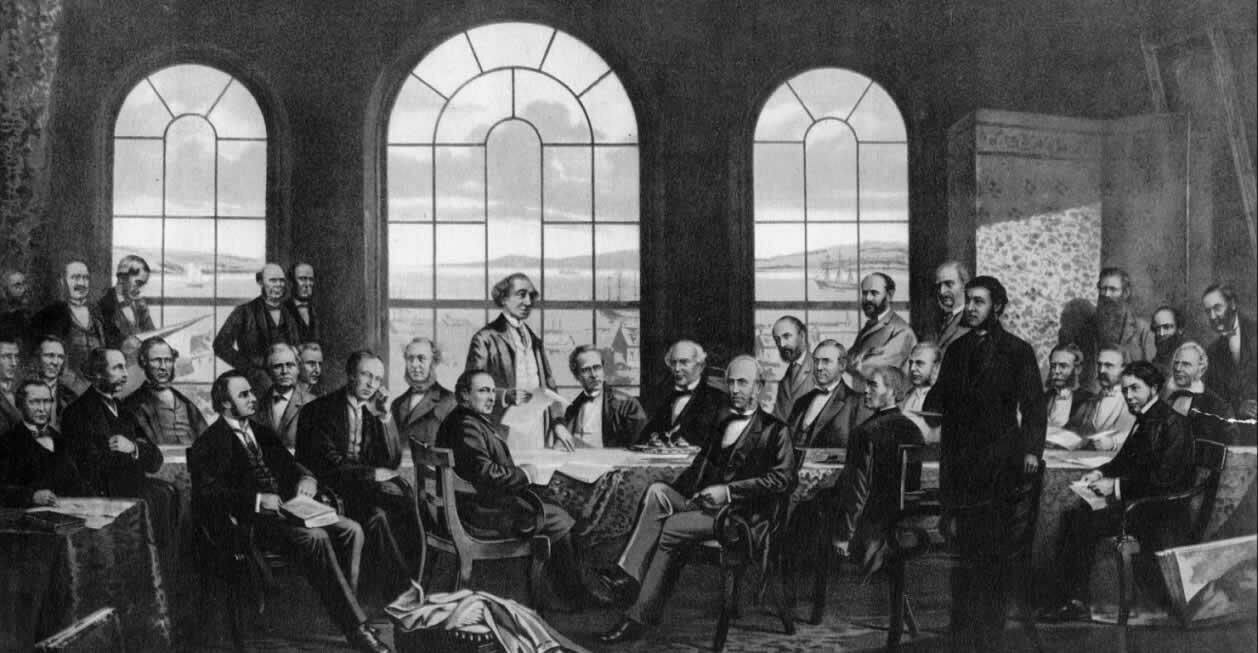
Reproduction print (circa 1890) after 1884 oil painting by Robert Harris.
This image was officially titled as "The Conference at Québec" where politicians from the British North American colonies gathered to discuss their unification into a single country. The image, better known as "The Fathers of Confederation" depicts the conference attendees, all male, some standing and some sitting, gathered in a meeting room in the Old Parliament Building overlooking the St. Lawrence River, near where the Fairmont Château Frontenac stands today in Québec City.
The absence of women's voices in the narrative of Canada's Confederation has been noted by historians; however, there were women who participated in this nation-building effort in different ways. These women are collectively known as the "Mothers of Confederation" (see Web Links below).Context
The Québec Conference was held October 10-27, 1864 to consider a union of the five British North American provinces. The conference resulted in the "seventy-two resolutions", 50 of which were written by John A. Macdonald, that were to form the basis of an independent Canada under the British Crown and Canada’s Constitution, and ultimately Canadian Confederation.
In 1866-1867, the resolutions were turned into legislation by delegates at the London Conference. That legislation became the British North America Act, which created the Dominion of Canada. The BNA act was passed by the British Parliament and became law on July 1, 1867.
_____________________
Delegates to the Québec Conference:
Canada East
- George-Étienne Cartier, Jean-Charles Chapais, Alexander Tilloch Galt, Hector-Louis Langevin, Thomas D'Arcy McGee and Étienne-Paschal Taché
Canada West
- George Brown, Alexander Campbell, James Cockburn, John A. Macdonald, William McDougall and Oliver Mowat
New Brunswick
- Edward Barron Chandler, Charles Fisher, John Hamilton Gray, John Mercer Johnson, Peter Mitchell, William H. Steeves and Samuel Leonard Tilley
Nova Scotia
- Adams George Archibald, Robert B. Dickey, William Alexander Henry, Jonathan McCully, Charles Tupper, John William Ritchie and Joseph Howe
Prince Edward Island
- George Coles, John Hamilton Gray, Thomas Heath Haviland, Andrew Archibald Macdonald, Edward Palmer, William Henry Pope and Edward Whelan
Newfoundland (observers)
- Frederick Carter and Ambrose Shea