Description
Painting
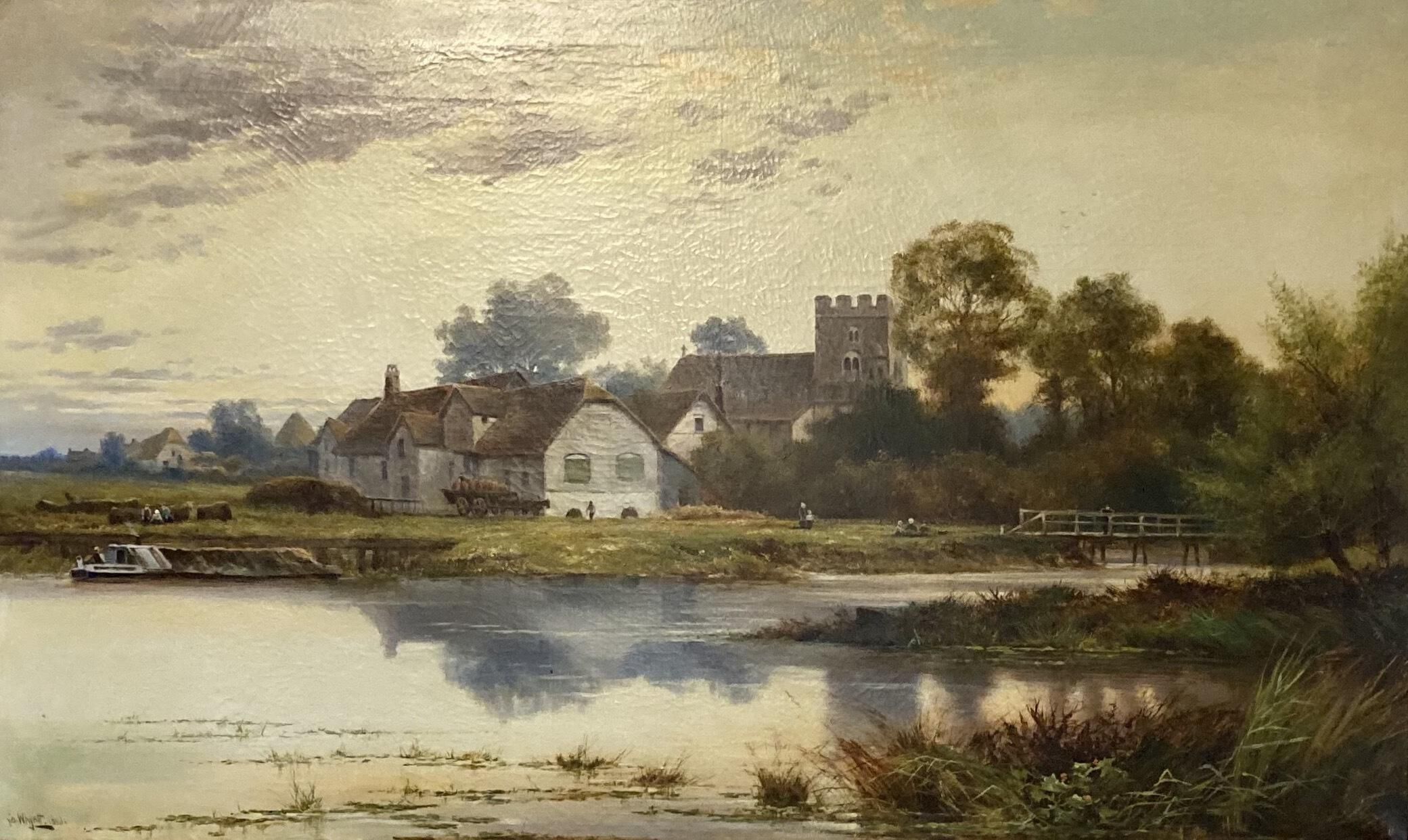
This Realist pastoral image depicts The Goring, a village on the left bank of the River Thames in the Goring Gap, South Oxfordshire, England between the Berkshire Downs and Chiltern Hills. Some villagers are visible in front of thatched and stone houses, a mill and a church (St. Thomas of Canterbury) with clumps of trees, and a narrow canal-type boat is moored along the river bank to the left. There is a small bridge on the right with trees and reeds in the foreground. It is a picturesque scene, with the sky, buildings and trees reflected in the water.Type of Painting
EaselContext
The picturesque town of The Goring on the River Thames has long been a popular spot for artists, photographers and nature-lovers alike and many depictions, often focusing on the Norman church tower, have been produced, from sketches such as by Joseph Mallord William Turner RA (1775–1851) in 1806/7, to oil paintings, to early photographs to picture postcards and more. Indeed, the River Thames is beloved and one of its most successful Victorian promoters was the professional photographer Henry William Taunt FRGS (1842-1922). In the 1870s, Taunt produced the first pocket guide to the River Thames to be illustrated with photographs. This was followed by further related publications by Taunt and others. More recently, two digital photographers, Jeff Robins and Graham Diprose were inspired by Taunt’s first photographic guides to the river and set out to recapture his images photographically some 125 years later. See Web links below.
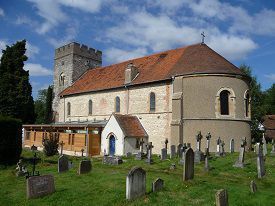
The St. Thomas of Canterbury Church, situated in the heart of Goring, was built about 1100, likely by Robert d'Oilly, a Norman baron and staunch supporter of William the Conqueror. The church underwent major repair, interior reordering and the addition of an extension in 2009.
In 1837 a wooden toll bridge was built across the Thames to connect the twin towns of Goring (Oxfordshire) with Streatley (Berkshire). At the time, Streatley was the more important neighbour with its road to both Reading and Oxford. However, in 1840, with the arrival of the railway, Goring became the larger and more significant. A current bridge was built in 1923.