Description
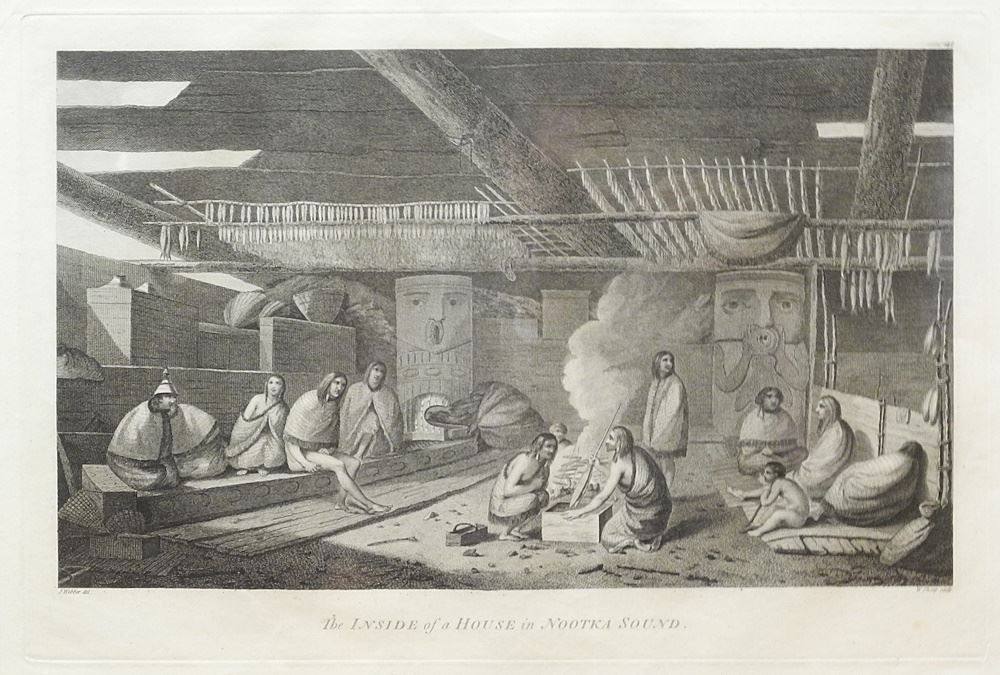
Steel engraving illustration 1784 by William Sharp (1749-1824) after 1778 drawing by John Webber (1751-1793).
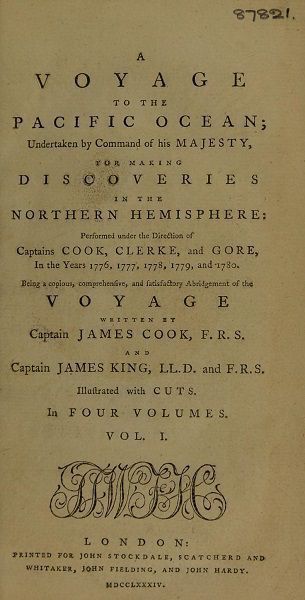
From Captain James Cook, F.R.S. and Captain James King, LL.D. and F.R.S. 1784. "A Voyage to the Pacific Ocean; Undertaken by Command of his Majesty, for making discoveries in the Northern Hemisphere: Performed under the Direction of Captains Cook, Clerke, and Gore, in the Years 1776, 1777, 1778, 1779, and 1780. Being a copious, comprehensive, and satisfactory Abridgement of the Voyage." London: J. Fielding Paternoster Row. Printed for John Stockdale, Scatcherd and Whitaker, John Fielding, and John Hardy. Vol. II, page 316?, plate 42.
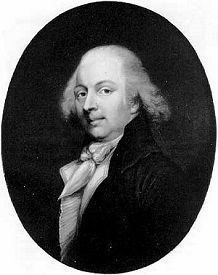
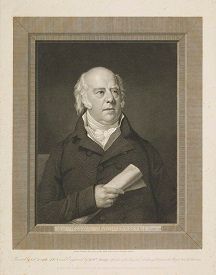
Of note, the publication of Cook’s third voyage was unprecedented in terms of the amount of money spent on the illustrations that accompanied the expedition text. In fact, the priority given to quality artwork set the standard for subsequent publications on voyages of discovery.
______________________
As part of his expedition to explore the coasts of the Pacific Ocean and to determine the possibility of a North-West Passage, Cook traveled to Nootka Sound (King George's Sound) on the north-west coast of Vancouver Island between March 29 and April 26, 1778. Cook's arrival marked the first recorded European landing on what would become British Columbia. Some of Webber's drawings can be dated precisely to April 22 when he accompanied Cook to the village of Yuquot or Nootka on Nootka Island in Nootka Sound. Reportedly, this represents one of the significant and earliest examples of accurate depictions of First Nations peoples, dwellings, culture and scenery. Indeed, Webber's collective works from the entire Pacific voyage was the most comprehensive record of sights in the Pacific region ever produced.
This image is an interior scene of a house in Nootka. A stone boiling box with a man working on either side is a focal point of the image. Steam/smoke is rising upwards and a large number of salmon, likely smoked, are suspended from poles on the roof ceiling. There are various openings in the roof for the entry of light, fresh air and the escape of fire smoke. A dozen First Nations individuals in traditional clothing are shown doing various activities such as cooking and weaving with some seated on raised mats or benches. Two large carved wooden "supreme being" sculptures are placed at the back in front of and to the side of various raised platforms with wooden cooking and storage boxes and baskets.
Cook reportedly and rightly assumed that these houses were used on a temporary basis as the Nootka people changed locations with the availability of seasonal marine and land resources such as fish, whales, berries, bark, etc. Removable planks fixed to permanent frames formed these large pre-fabricated multi-generational or multi-family houses. These same planks were used to transport belongings and were then re-used to make new houses at the new location.Context
Yuquot or Nootka is located on Nootka Island in Nootka Sound, just west of Vancouver Island, B.C. It was the summer home of Chief Maquinna (fl. 1778-95) and the Mowachaht/Muchalaht (Nuu-chah-nulth) people for generations, with some 1,500 people in 20 traditional wooden longhouses. The name means "Wind comes from all directions" in Nuuchahnulth.
The Nuuchahnulth, formerly referred to as the Nootka, Nutka, Aht or Tahkaht, are one of the First Nations peoples of the Pacific Northwest Coast in Canada. The term Nuuchahnulth, meaning " all along the mountains and sea" and used as a collective term of identification, was chosen in 1979 by the thirteen tribes whose traditional home is the western coast of Vancouver Island, B.C. The Makah of northwest Washington are also Nuuchahnulth.
- Plaque(s) from Parks Canada: Yuquot National Historic Site of Canada
Yuquot, Nootka Island, British Columbia
Discovered by Captain James Cook, in March 1778. In June, 1789, Spain took possession and established and maintained a settlement until 1795. The capture of British vessels, in 1789, almost led to war, which was avoided by the Nootka Convention 1790. Vancouver and Quadra met here, in August, 1792, to determine the land to be restored under that convention.
To the Mowachaht-Muchalaht First Nations, Yuquot has always been the centre of their social, political and economic world. Whaling was a vital part of the life of the Mowachaht-Muchalaht, and of all the Nuu-chah-nulth peoples. Near here once stood the Whalers Washing House*, a unique ceremonial structure and the most significant monument to a purification ritual on the West Coast of North America. In the late 18th century, Yuquot became an important site of early contact between First Peoples and Europeans. Explorers and traders were attracted to this safe harbour, which they called Friendly Cove. As a result, Yuquot, also known as Nootka, developed into an important centre of trade and diplomacy, and it was briefly the site of Spain's only military establishment in present-day Canada. Yuquot became the focal point of the Nootka Sound Controversy of 1789-1794, when the rival interests of Great Britain and Spain brought those countries to the brink of war.
*The Whaler's Washing House or Shrine was designated a national historic site of Canada in 1983 and was a ceremonial site of purification rituals where whalers from the community prepared for hunting. It included carved items and was passed down through the family of a Yuquot chief. The American Museum of Natural History in New York came into possession of the items in 1900. However, in March 2025, the items were repatriated and returned to the Mowachaht/Muchalaht First Nation. The items included 88 carved wooden human figures, four carved wooden whales, and 16 human crania. See Web Links