Description
Print
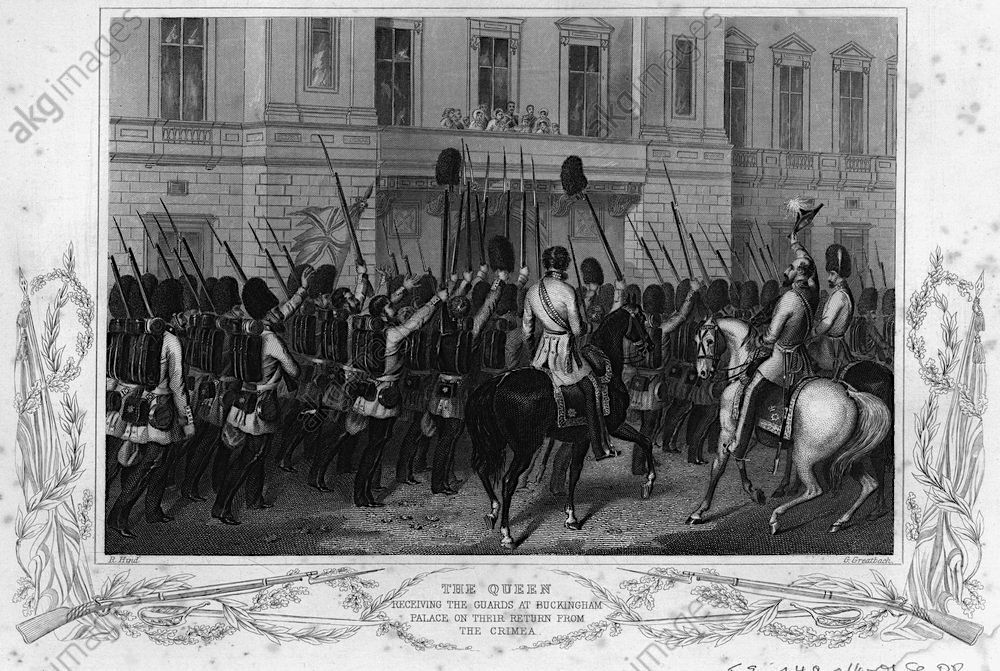
Steel engraving by George Greatbach after design by Robert Neal Hind.
From Williams, Lt. Colonel William Freke. 1857. "England's Battles by Sea and Land, Volume VI, Russia and Turkey". London: The London Printing and Publishing Company Limited.
This image depicts Queen Victoria and Prince Albert of Saxe-Coburg and Gotha as her consort, with other family members, on a balcony at Buckingham Palace, London, England. They are welcoming back the royal household regiment, the Coldstream Guards, after the Crimean (Russo-Turkish) War, 1853-1856. The regiment had served with distinction at the Battles of Alma, Inkerman and Sevastopol. Well-recognized over time for its high-profile ceremonial duties, the regiment had also earned a reputation as an elite fighting force.Context
While the alliance of France, the Ottoman Empire, the United Kingdom and Piedmont-Sardinia had won the Crimean War over Russia, the gains made were negligible and relations amongst the powers in eastern Europe were not settled. For the British, the war was deemed a disaster, becoming an iconic symbol of unclear objectives, logistical and tactical failures and overall command mismanagement. Conditions were brutal and the loss of life enormous due mainly to disease. Of note, it was the first war to use new inventions and technologies such as the electric telegraph, explosive shells and "live reporting". It was also the first European war to be photographed. Public opinion in Britain was united in outrage and the Tory government was ultimately forced to resign.
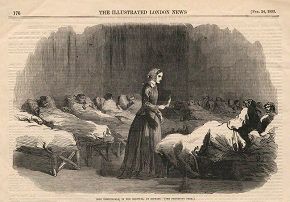
It was generally held that Florence Nightingale OM, RRC (1820-1910) was the only real hero of the war. She came to prominence when she served as manager and educator leading the pioneering efforts of her team of nurses in Constantinople (now Istanbul, Turkey) to establish new life-saving patient care and sanitation measures. She was also active as a social reformer, writer, and statistician setting up the first training school for nurses in the U.K., and she ultimately changed the face of nursing from a mostly untrained job to a highly skilled and well-respected medical profession. A Jamaican-born British nurse, Mary Seacole OM (Jamaica posthumous) (1805-1881), was also recognized for her care of sick and wounded military personnel. Post-war, the Royal family instituted an energetic propaganda campaign including the establishment of the Victoria Cross for valour introduced in early 1856 by Queen Victoria, as well as the production of mass circulation commemorative prints.
____________________
This engraving is from Lt. Colonel William Freke Williams', England's Battles by Sea and Land: Russia and Turkey (London: The London Printing and Publishing Company, 1854-1859). It is a six volume set of over 50 steel-engraved plates of battles, maps, etc. Williams authored and co-authored other military history publications such as "England's Battles By Sea And Land: History Of England's Campaigns In India And China" and "The Life and Times of the Late Duke of Wellington".