Description
Painting
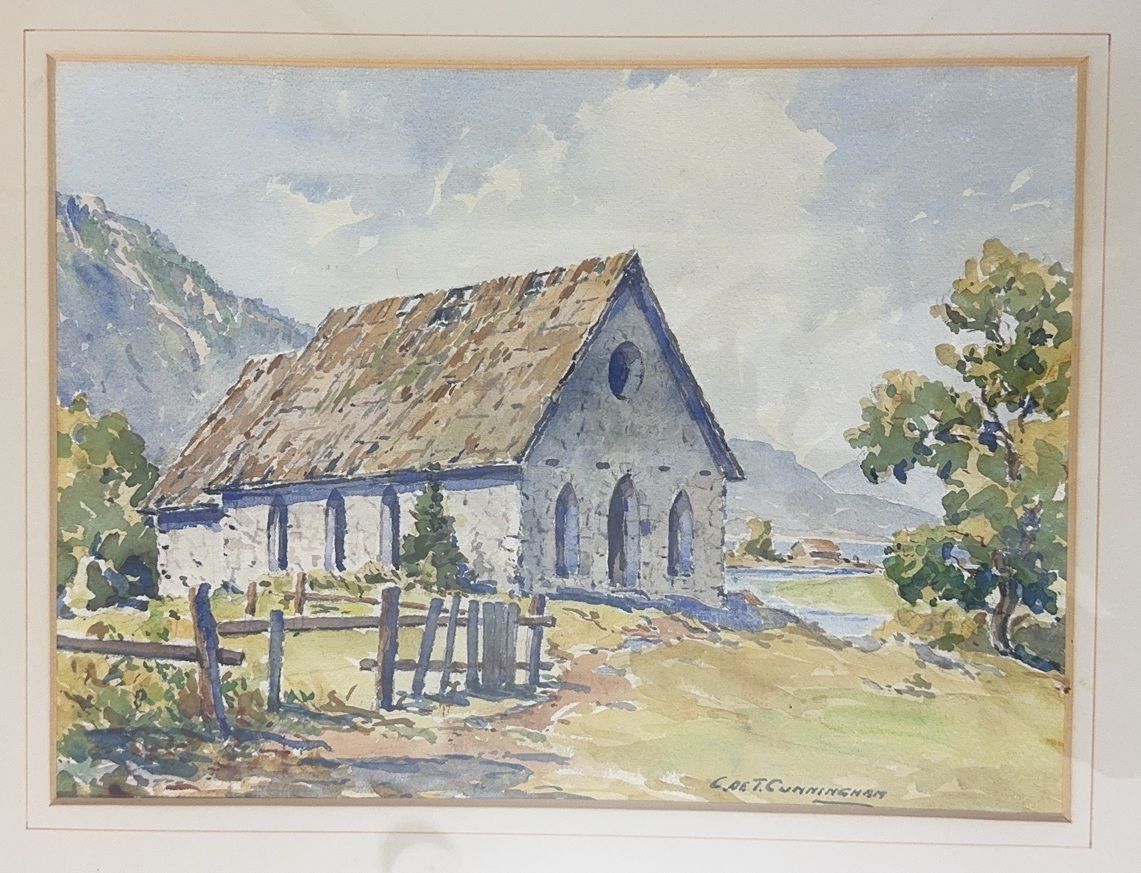
This scene depicts a now-abandoned 19th century sandstone church located on the Cowichan Indian Reserve on Comikan Hill in Duncan, on Vancouver Island B.C., overlooking Cowichan Bay. It is a softly rendered representation that balances scenic accuracy at the time with artistic expression.
The church is the focus of the image framed in part by fencing in the left foreground and a tree on the right. Mount Tzouhalem is shown to the left in the background. Tzouhalem was a legendary Cowichan chief, known as one of the most powerful First Nations Elders in the Pacific Northwest.Context
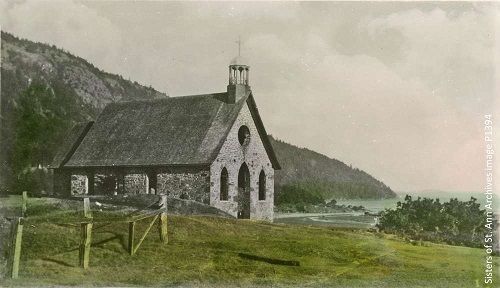
The church and its cemetery represent the history of the Cowichan First Nations territory and the early interactions between missionaries and the local Indigenous communities. The Stone Church was built in 1870 by the missionary Father Pierre Rondeault with First Nations help. Father Rondeault had arrived from Quebéc via Fort Victoria in 1858 and he set out to build a congregation in the Cowichan Valley.
Rondeault's first church was a small log building which he built himself with materials donated by local First Nations. He then went on to build the Stone Church atop the site of the original log one. The church was also known as the “Butter Church” (and also St. Ann's), as the Father paid his helpers with funds raised from the sale of butter from his dairy herd on the mission’s farm. Unfortunately, the church was only used for ten years (1870-1880), as it was discovered that the church had mistakenly been built on land without clear title, and the structure was abandoned for a new church ordered by Bishop Modeste Demers, first Bishop of Victoria. Rondeault also opened a school for First Nations boys, and went on to later build a log cabin to serve as school and convent for the Sisters of St. Ann who had arrived in 1864. Reportedly, the Father was highly respected by both the First Nations and non-Indigenous communities. A plaque marking his grave read: “This tomb was erected by Walter Morley Tzouhalem as a tribute of love and gratitude to the memory of Rev. Father Rondeault.”
The abandoned Stone Church was repeatedly vandalized over the years, developing a reputation as being haunted in the local community. Multiple repair attempts were made - in 1922 and 1958 as well as in 1980 when it was rebuilt as a cultural centre. However, the church ultimately reverted to its abandoned condition. Fortunately, the church's windows, front door, and bell were salvaged, transported and re-installed in St. Paul’s Church at Fulford Harbour, Salt Spring Island.
____________________________________
"The Sisters of St. Ann arrived in Victoria from Quebec in 1858 to establish education and health service for new settlers and Indigenous people. While many of their contributions are celebrated, in 2014 the Sisters acknowledged that their involvement in Canada’s Indian Residential Schools contributed to a form of cultural oppression that has had a lasting effect not only on those who attended the schools but also on subsequent generations." See HeritageBC: Web Links below