Description
Photograph
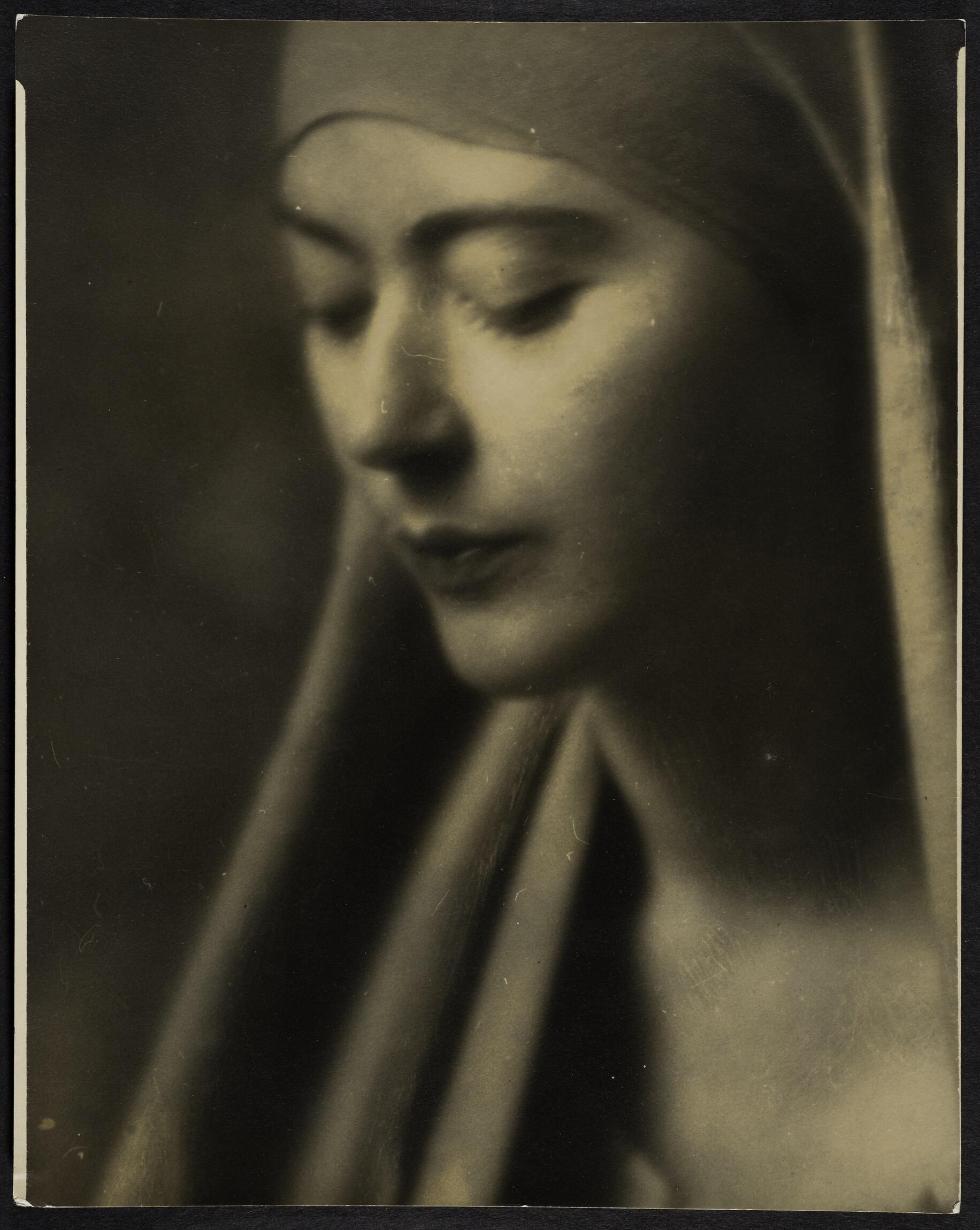
Photographic reproduction (2015) from the 1928 b/w photograph by John Vanderpant.
This black and white Pictorial-style image shows Vera (Olivia) Weatherbie (1909-1977), an artist and the second wife of photographer Harold Mortimer-Lamb, in the role of the Virgin Mary. It is a 3/4 head and shoulders view, both of which are modestly covered with a cloth shawl and she is gazing downward.
In 1928, in her last year as an undergraduate at the Vancouver School of Decorative Arts and Applied Design (VSDAA, now Emily Carr University of Art and Design), Weatherbie played the role of the Virgin Mary in the school’s Christmas play entitled “The Christmas Pageant of the Holy Grail”. John Vanderpant attended the play and later photographed Weatherbie in her costume at his studio.Context
Vera Weatherbie was a Vancouver painter and one of the first graduates of the Vancouver School of Decorative and Applied Arts (VSDAA, now Emily Carr University of Art and Design). She won a number of awards during her studies, and was well-known both as a model and muse for such artists as Frederick Varley and her spouse Harold Mortimer Lamb. In particular, she was recognized for her connections with the Canadian Group of Seven Painter, Frederick Horsman Varley RCA (1881-1969), who painted his sometime lover, Vera, a number of times. One of his portraits, an unsettling blue-green portrayal entitled "Vera" done in 1931 is considered iconic in Canadian art.
Weatherbie completed her post-graduate studies at the Royal Academy in London, England after graduation from VSDAA, and was later hired as an instructor teaching drawing, composition and painting at the B.C. College of Arts, founded in part by Varley, until it closed due to financial troubles in the mid 1930s. She exhibited her work in the B.C. Artists exhibitions at the Vancouver Art Gallery from 1932 to 1952, winning the Beatrice Stone Medal in Painting in 1934. She also exhibited at other venues in Vancouver, Seattle and at national exhibitions into the 1950s.
Of note, like other Canadian artists of Modernism at the time, Weatherbie was interested in religions and religious philosophy, educating herself in mysticism and auras, and her portraits and landscapes embraced spiritual connections in a way that set her apart from her contemporaries.
_____________________________
Pictorialism was an international style and the predominant aesthetic movement in photography during the later 19th and early 20th century, and beyond into the 1940s in some areas. It began in response to the advent of the amateur Kodak camera in 1888 and claims that a photograph was easily taken, simply a record of reality, and it later transformed into a movement to advance the status and principals of photography as a true art form. Pictorialists believed that photography should be understood as a means of personal expression and creativity equal to other fine arts like painting and printmaking.
Pictorialism had its roots in England with the establishment in 1892 of the Linked Ring Brotherhood by Henry Peach Robinson (1830-1901), George Davison (1854-1930) and Henry Van Der Weyde (1838-1924). This invitation-only British pictorialist group seceded from the Royal Photographic Society. And similar groups were formed in Paris, Berlin, Hamburg and Brussels. In 1902 Alfred Stieglitz (1864-1946) formed the American Pictorialist photographers group, the Photo Secession movement, with Alvin Langdon Coburn (1882-1966), Frederick Holland Day (1864-1933), Frank Eugene (1865-1936), Gertrude Käsebier (1852-1934), Edward Steichen (1879-1973) and Clarence White (1871-1925). In 1916 Coburn, Käsebier, White and others formed an organization called the Pictorial Photographers of America (PPA) to continue promotion of the pictorial style. A year later Stieglitz formally dissolved the defunct Photo Secession group.
Pictorial photographers were dedicated to conveying an emotion, thought or sentiment through their careful choice of subject matter, composition, tonal balance and technique. There is no standard definition of 'pictorialism', but overall it refers to a style in which the photographer has "created" rather than just accurately "recorded" an image. Typically, such photos have a soft focus, and may be printed in colours such as warm brown or deeper blue, and may have visible surface treatments that were created in the darkroom.