Description
Print
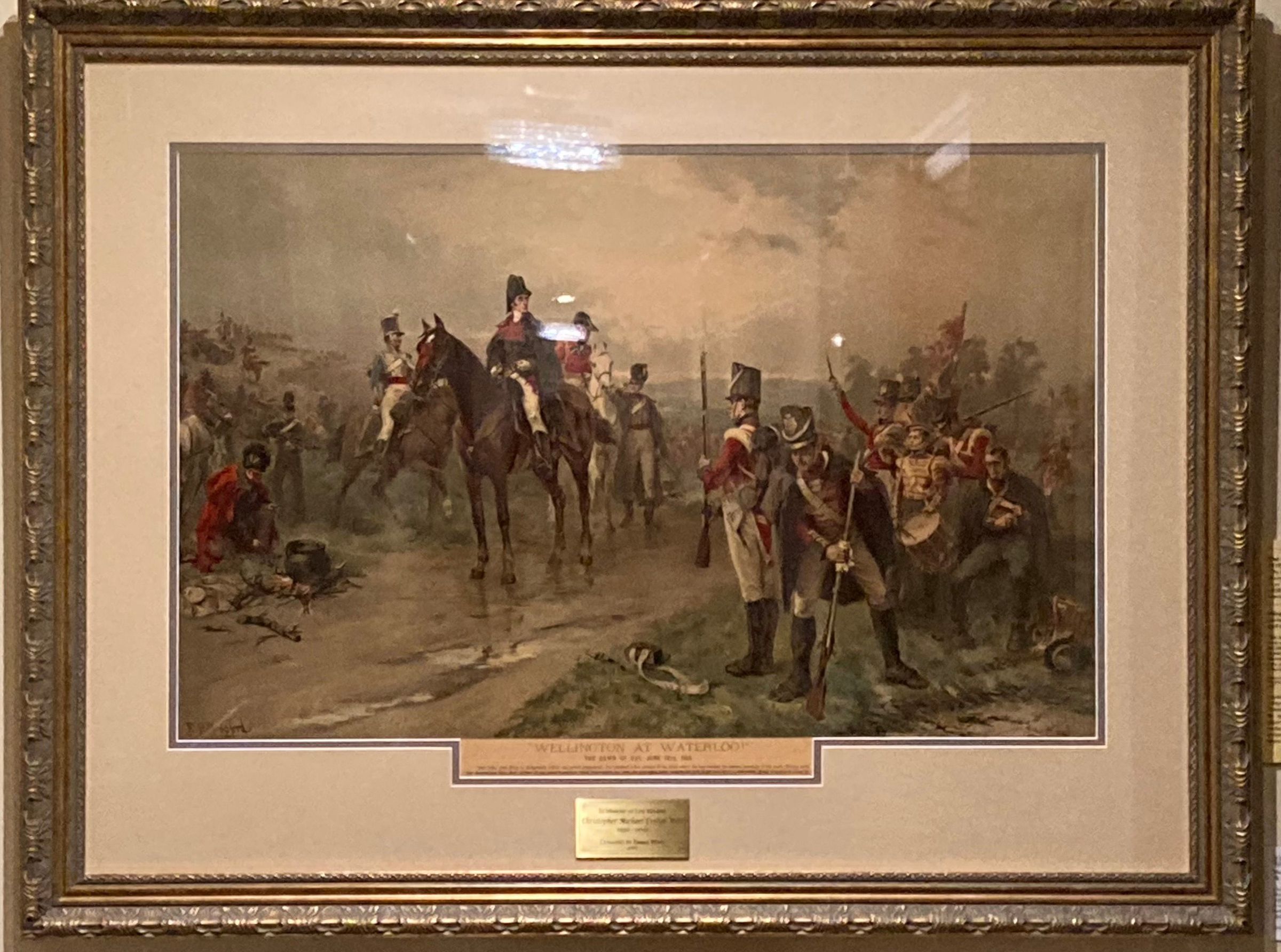
Reproduction print (1896) after oil painting (date unknown) by Robert Alexander Hillingford. Published in the supplement to "Holly Leaves", "The Illustrated Sporting and Dramatic News Christmas Number November 28th, 1896", London, England.
The central figure on horseback is Arthur Wellesley, 1st Duke of Wellington, KG, KB, MP at dawn on the day of the Battle of Waterloo on Sunday, June 18, 1815, near Waterloo in Belgium, part of the then United Kingdom of the Netherlands. At Waterloo, Wellington commanded the allied army which, together with a Prussian Army under Field Marshal Gebhard von Blücher, defeated Napoléon Bonaparte. Napoléon was forced to abdicate, bringing an end to the Napoléonic era of European history.Context
This image reportedly represents a moment just before the battle as described by Sergeant-Major Edward Cotton (late of the 7th Hussars) when the Duke of Wellington surveyed his troops riding to Hougoumont Château and farm. Hougoumont became an epicenter of fighting in the Battle of Waterloo as it was one of the first places where British and allied forces faced Napoléon's army.
- From " A Voice from Waterloo, A History of the Battle Fought on the 18th June 1815", London, 1817.
"The morning of June 18, 1815 saw 180,000 men, 60,000 horses and 500 pieces of artillery crammed into 2½ sq miles of Belgian countryside. In the nine frantic hours that followed, a quarter-century of central European warfare was brought to a close, leaving more than 44,000 dead, dying and wounded on the field. It was an extraordinary event."
Extract from The Battle of Waterloo, Extraordinary Edition, 2015 (See Web Links below).
___________________________
Born in Dublin, the Duke of Wellington (1769-1852) was an Anglo-Irish soldier and Tory statesman who was one of the leading military and political figures of 19th century Britain, serving twice as British prime minister, 1828-1830 and in 1834. He was a leading figure in the House of Lords until his retirement and remained Commander-in-Chief of the British Army until his death. He was known for his consistent political resolve and is considered to be one of the greatest defensive commanders of all time, with many of his tactics and battle plans still studied in military academies worldwide.
Born in Corsica, Napoléon Bonaparte (1769-1821) was a French military commander and political leader who rose to prominence during the French Revolution, leading successful campaigns during the Revolutionary Wars. He was in effect the leader of the French Republic as First Consul 1799-1804, then becoming the French Emperor, 1804-1814 and 1815. His legacy endures, as liberal reformer, controversial leader and one of the greatest military commanders in history. And like Wellington, his military tactics and campaigns continue to be studied across the globe.
_____________________________
The Battle of Waterloo, and the defeat of Napoléon, was significant in many ways. It marked the end of some 750 years of sporadic Anglo-French conflict, and also roughly the end of French domination on the European and world stage and the start of England's supremacy. Of note, there followed almost four decades of international peace in Europe. No further major international conflicts occurred until the Crimean War in the 1850s.