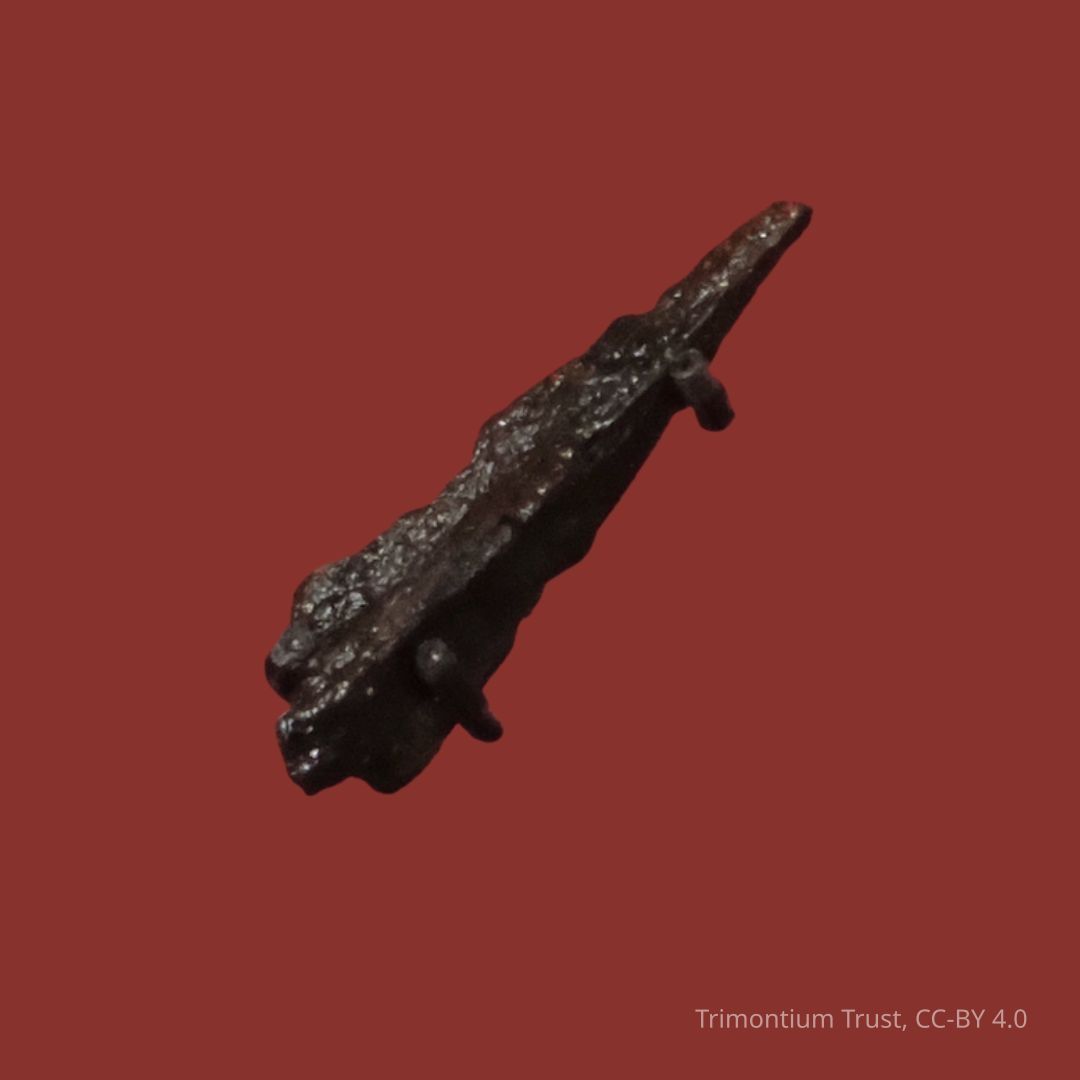
Barbed and Tanged Arrowhead
Overview
Description
Syrian-style, iron barbed and tanged arrowhead, three-edged, fluted with a triangular-sectioned head, from the Roman site at Newstead (Trimontium), Roxburghshire. 2nd century AD.Context
Part of Newstead Collection. Updated from SCRAN full data set, December 1998.Collection
National Museums Scotland, Newstead CollectionUse
Used and designed for armour penetration, and mass firepower, archery played a secondary role to the sword (gladius) and spear (pila).
Category
Military Equipment & Weaponry
Acquisition
Accession
X.FRA 211Source (if not Accessioned)
National Museums ScotlandNotes
Loan - L.2021.37Made/Created
Time Period
2nd centuryEthnography
Cultural Region
Continent
EuropeCulture/Tribe
Romano British
Lexicon
Nomenclature 4.0
Nomenclature Primary Object Term
ArrowNomenclature Sub-Class
Edged WeaponsNomenclature Class
ArmamentsNomenclature Category
Category 05: Tools & Equipment for Science & TechnologyGetty AAT
Concept
arrowheadsOther Names and Numbers
Name Type
Previous Accesssion NumberOther Name
I 15-54Dimensions
Length
3.2 cmMaterials
Iron
Colors
Granite
Condition
Overall Condition
GoodRelationships
Related Person or Organization
Person or Organization
James CurleNotes
ExcavatorRelated Publications
Publication
A Roman Frontier Post and Its PeopleNotes
P. 189, Plate XXXVIII, Figure 5Provenance
Provenance Detail
1905 - 1911 ExcavationsAcquisition Method
FoundExhibitions
Permanent Exhibition