Helmet/Ear Guard
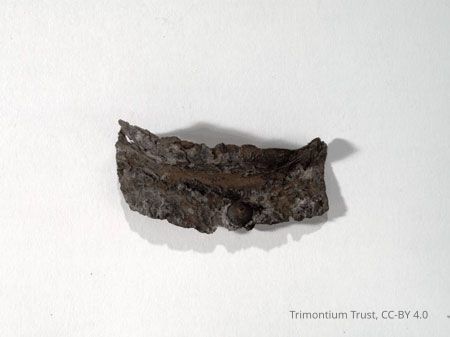
Image © National Museums Scotland
Overview
Description
Ear guard fragment of bronze, from an auxiliary cavalry helmet, from the Roman site at Newstead (Trimontium), Roxburghshire. 80 - 100 AD.Context
Part of Newstead Collection. [National Museums Scotlaand description] Bloodshed, weapons and heroes » Roman military equipment » Auxiliary cavalry » Helmets and fittings » Ear guard fragment, Newstead. 80 - 100 AD. [Scran caption] This bronze ear guard for a helmet was found during excavations at the site of the Roman fort at Newstead in Roxburghshire. It is part of a helmet worn by a member of the auxiliary cavalry between 80 and 100 AD. The guard is rectangular in shape, and curved. It is now fragmentary and corroded. There were two classes of Roman soldiers: the elite legionary and the ordinary auxiliary, each with its own equipment. Every soldier, infantry and cavalry, was fully equipped. Military equipment was mass produced.Collection
National Museums Scotland, Newstead CollectionUse
An ear guard would be attached to the helmet, to help protect the wearer's ears from trauma.
Category
Helmet
Military Dress & Armour
Acquisition
Accession
X.FRA 127Source (if not Accessioned)
National Museums of ScotlandMade/Created
Time Period
1st - 2nd Century ADEthnography
Cultural Region
Continent
EuropeCulture/Tribe
Romano British
Lexicon
Nomenclature 4.0
Nomenclature Secondary Object Term
Helmet, MilitaryNomenclature Primary Object Term
HelmetNomenclature Sub-Class
HeadwearNomenclature Class
ClothingNomenclature Category
Category 03: Personal ObjectsGetty AAT
Concept
helmets (protective wear)Other Names and Numbers
Name Type
Previous Accesssion NumberOther Name
I 15-3Dimensions
Length
65 mmMaterials
Bronze
Colors
Brown, Black