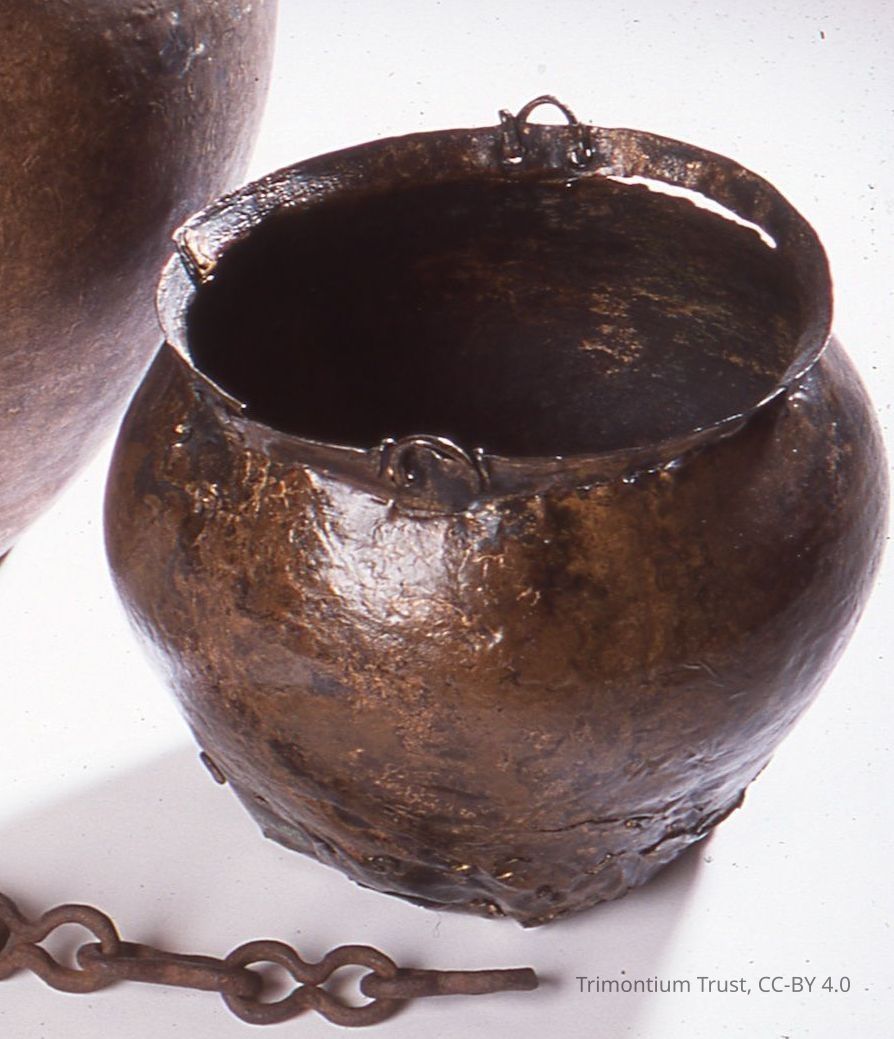
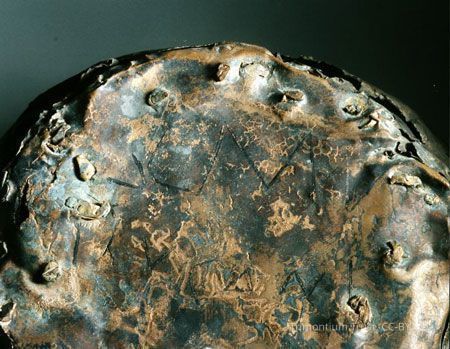
Bronze camp kettle with a Latin inscription reading 'The troops of Lucanus' punched twice on the bottom, from the Roman site of Newstead (Trimontium), late 1st or 2nd century AD
Use
Kettles were used by the soldiers to eat various types of soups and porridge.
Context
Be it on the road or settled in camp, a Roman soldier was responsible for his own weapons and tools, one of which is the kettle for his meals.
Found in Pit XIV
Collection
National Museums Scotland
Category
Kettle
Food Preparation & Storage
Acquisition
Accession
X.FRA 1190
Source (if not Accessioned)
National Museums of Scotland
Made/Created
Date made
80 - 180
Time Period
1st - 2nd Century AD
Ethnography
Cultural Region
Continent
Europe
Culture/Tribe
Roman
Inscription/Signature/Marks
Type
Inscription
Location
Bottom
Transcription
LVCANI
Language
Latin
Translation
The troops of Lucanus
Material/Technique
punched
Lexicon
Nomenclature 4.0
Nomenclature Secondary Object Term
Kettle
Nomenclature Primary Object Term
Cookware
Nomenclature Sub-Class
Cooking Vessels
Nomenclature Class
Food Processing & Preparation T&E
Nomenclature Category
Category 04: Tools & Equipment for Materials
Getty AAT
Concept
kettles (vessels)
Other Names and Numbers
Other Numbers
Number Type
Previous Accession Number
Other Number
I.15.108
Material
Bronze
Color
Bronze, Green, Tan
Relationships
Related Person or Organization
Person or Organization
James Curle
Notes
Excavator
Related Publications
Publication
Clarke, D.V., Breeze, D.J., and Mackay, G. The Romans in Scotland. An introduction to the collections of the National Museums of Antiquities of Scotland. Edinburgh: National Museum of Antiquities of Scotland, 1980, p. 43.
"Roman Frontier Post and Its People" p.274. Pl. LIII, 6
"...Fig. 6, which is much smaller in size, and has been a good deal battered and mended, has the name LVCANI cut twice upon the bottom."