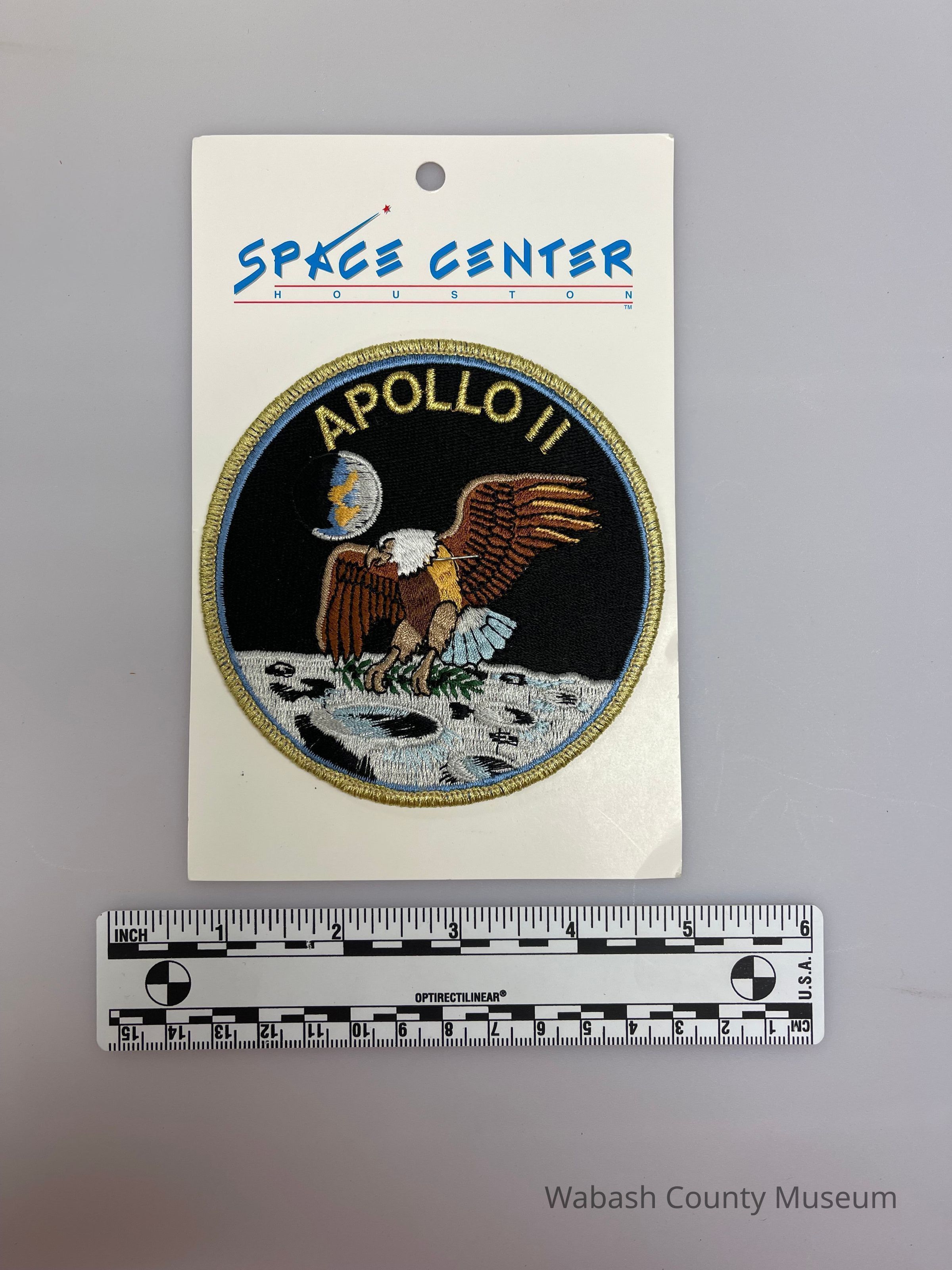
Name/Title
NASA Mission Patch - Apollo 11 Mission PatchEntry/Object ID
2024.039.22Description
NASA Mission Patch - Apollo 11 Mission Patch
The purpose of the Apollo 11 mission was to land men on the lunar surface and to return them safely to Earth. The crew was Neil A. Armstrong, commander; Michael Collins, Command Module pilot; and Edwin E. Aldrin Jr., Lunar Module pilot. After a rest period, Armstrong and Aldrin entered the Lunar Module preparing for descent to the lunar surface. The two spacecraft were undocked at about 100 hours, when the Command and Service Modules separated from the Lunar Module. The spacecraft landed in the Sea of Tranquillity at 4:18 p.m. EDT. Afterwards, they ate their first meal on the Moon and decided to begin the surface operations earlier than planned. A lunar module camera provided live television coverage of Armstrong setting foot on the lunar surface at 10:56 p.m. EDT. Just as he stepped off the lunar module Neil Armstrong proclaimed, "That's one small step for man, one giant leap for mankind." Aldrin emerged soon after, setting foot on the lunar surface at 11:16 p.m. EDT. Aldrin evaluated his ability to operate and move about and was able to move about rapidly and with confidence. Forty-seven pounds of lunar surface material were collected to be returned for analysis. The surface exploration was concluded in 2 hours, when the crew reentered the lunar module. After lunar ascent, the Lunar Module docked with the Command and Service Modules at 128 hours. The crew transferred into the Command and Service Modules, the ascent stage was jettisoned and they prepared for trans-Earth injection. Only one midcourse correction was required, and passive thermal control was used for most of trans-Earth coast. Bad weather made it necessary to move the splashdown point 346 kilometers (215 miles) downrange. Atmospheric entry phase was normal, and the command module landed in the Pacific Ocean at 195 hours. The landing coordinates, as determined from the onboard computer, were 13 degrees 30 minutes north latitude and -169 degrees 15 minutes east longitude.With the success of Apollo 11, the national objective to land men on the Moon and return them safely to Earth had been accomplished.
The story of the Apollo 11 patch is well documented by crewmember Michael Collins:
There were also a variety of non-technical chores, such as thinking up names for our spacecraft and designing a mission emblem. We felt Apollo 11 was no ordinary flight, and we wanted no ordinary design, yet we were not professional designers. NASA offered to help us along these lines (wisely, I think). On Gemini 10, which in my view has the best-looking insignia of the Gemini series, artistic Barbara Young had developed one of John’s ideas and come up with a graceful design, an aerodynamic X devoid of names and machines. This was the approach we wanted to take on Apollo 11. We wanted to keep our three names off it because we wanted the design to be representative of everyone who had worked toward a lunar landing, and there were thousands who could take a proprietary interest in it, yet who would never see their names woven into the fabric of a patch. Further, we wanted the design to be symbolic rather than explicit. On Apollo 7, Wally’s patch showed the earth and an orbiting CSM trailing fire. On 9, McDivitt produced a Saturn V, a CSM, and an LM. Apollo 10’s was even busier. Apollo 8’s was closer to our way of thinking, showing a figure eight looping around earth and moon, on a command-module-shaped patch, but it had, like all the rest, three names printed on it. We needed something simpler, yet something which unmistakably said peaceful lunar landing by the United States. Jim Lovell, Neil’s backup, introduced an American eagle into the conversation. Of course! What better symbol — eagles landed, didn’t they? At home I skimmed through my library and finally found what I wanted in a National Geographic book on birds: a bald eagle, landing gear extended, wings partially folded, coming in for a landing. I traced it on a piece of tissue paper and sketched in an oblique view of a pockmarked lunar surface.
Thus the Apollo 11 patch was born, although it had a long way to go before final approval. I added a small earth in the background and drew the sunshine coming from the wrong direction, so that to this day our official insignia shows the earth over the lunar horizon like when it really should look like . I also penciled APOLLO around the top of my circular design and ELEVEN around the bottom. Neil didn’t like the ELEVEN because it wouldn’t be understandable to foreigners, so after trying XI and 11, we settled on the latter and put APOLLO 11 around the top. One day outside the simulator I was describing my efforts to Jim Lovell, and he and I both agreed that the eagle alone really didn’t convey the entire message we wanted. The Americans were about to land, but so what? Tom Wilson, our computer expert and simulator instructor, overheard us and piped up, Why not an olive branch as a symbol of our peaceful expedition? Beautiful! Where do eagles carry olive branches? In their beaks, naturally. So I sketched one in, and after a few discussions with Neil and Buzz over color schemes, we were ready to go to press. The sky would be black, not blue, but absolute black, as in the real case. The eagle would be eagle-colored, the moon moon-colored, as described by Apollo 8, and the earth also, so all we had left to play with, really, were the colors of the border and the lettering. We picked blue and gold, and then we had an illustrator at MSC [James R. Cooper] do the artwork for us. We photographed the finished design and sent a copy through channels to Washington for approval. Washington usually rubber-stamped everything. Only this time they didn’t, and our design came back disapproved.The reason? The eagle’s landing gear, powerful talons extended stiffly below him, was unacceptable. It was too hostile, too warlike; it made the eagle appear to be swooping down on the moon in a very menacing fashion, according to Bob Gilruth. What to do? A gear-up approach was unthinkable to this pilot who had woken up more than once with cold sweats over a dreamed wheels-up landing. Perhaps the talons could be relaxed and softened a bit, made limp like a receiving-line handshake. Then someone had a brainstorm: just transfer the olive branch from beak to claw and all the menace disappeared. The eagle looked slightly uncomfortable in the new version, clutching his branches tightly with both feet, but we resubmitted it anyway, and it greased on through channels and won final approval.
Eisenhower dollarYears later the eagle still pops out at me from unfamiliar places, and the design has even found its way onto the reverse side of the part-silver Eisenhower dollar. This coin was issued during John Connally’s short stint as Secretary of the Treasury, and he was kind enough to pen me a short note in August 1971 stating, among other things: “... the design on the reverse is a rendering of the Apollo 11 insignia.” As if I didn’t know. The “designer” of the coin’s eagle told the press that it was a "happy" eagle, but I don’t know, it still looked uncomfortable to me. I just hoped that it dropped that olive branch before landing.
—Michael Collins, Carrying the Fire
In addition to the Eisenhower silver dollar, the Apollo 11 “eagle landing on the moon” design also appeared on the reverse of the Susan B. Anthony one-dollar coin first issued during the Carter administration.
Obviously popular with patriotically minded astronauts, the Eagle has appeared as a design motif on two additional Apollo mission patches (16 and 17), and on 9 Shuttle mission patches. Its last appearance was on the STS-54 mission patch in 1993.