Name/Title
NASA Mission Patch - Skylab II (Bean, Garriott, Lousma)Entry/Object ID
2024.039.1Description
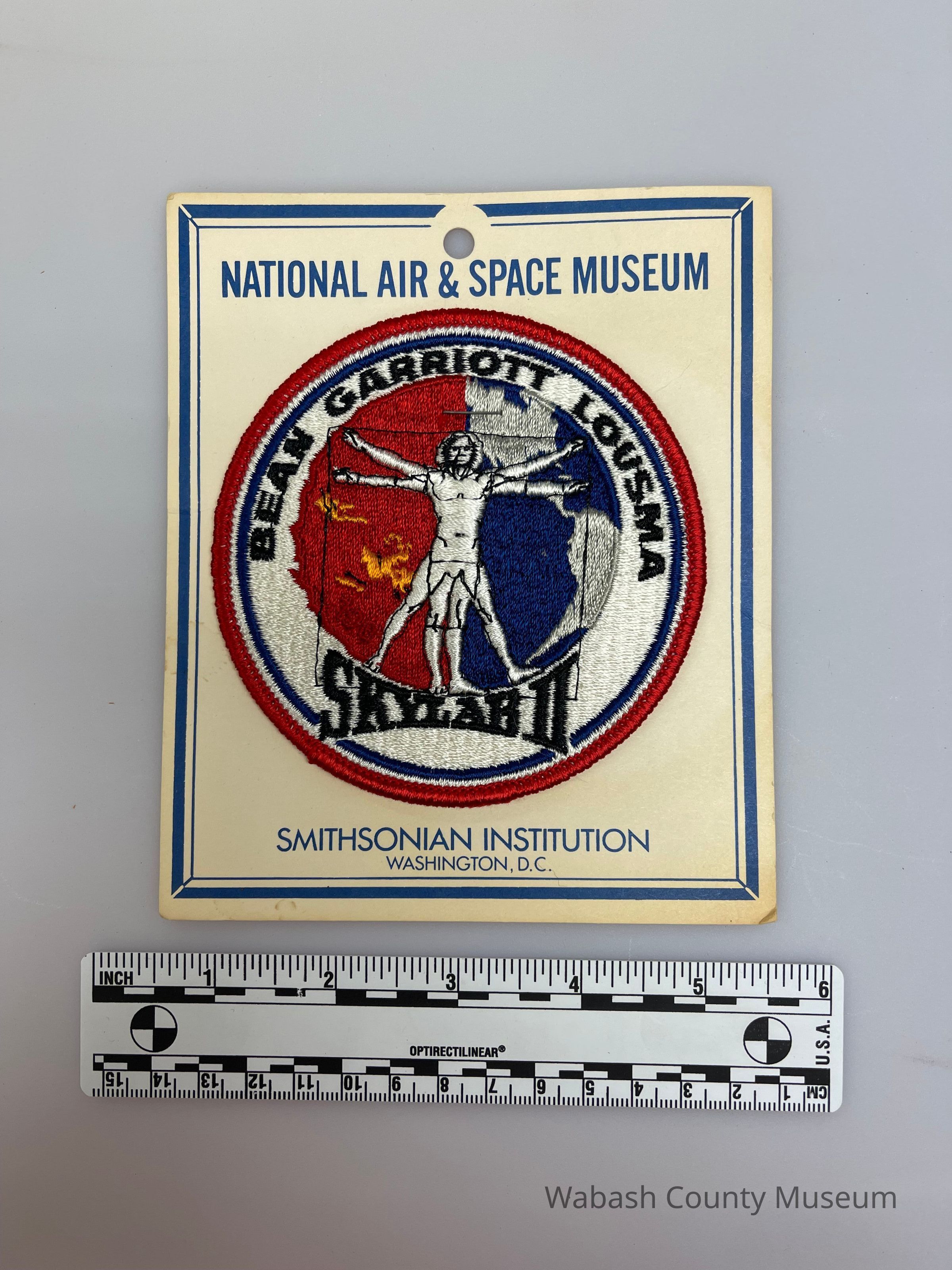
NASA Mission Patch - Skylab II (Bean, Garriott, Lousma). This Skylab 2 Patch measures 3 inches in diameter and was produced by NASA's official patch manufacturer, AB Emblem. Skylab was the first US orbital space station. Skylab 2 was the second of three missions to the space station, and was launched on top of a Saturn IB rocket on July 28, 1973. The mission was crewed by Commander Alan Bean, Science Pilot Owen Garriott and Pilot Jack Lousma. The mission lasted for 59 days, 11 hours, 09 minutes, 01 seconds, and travelled approximately ravelled 39,400,000 kilometres.
Skylab 2 Patch
Measures 3 Inches in Diameter
Manufactured by AB Emblem
Official NASA Patch
The Skylab Expedition 2 patch has as its central image an adaptation of a drawing by Leonardo da Vinci, which was inspired by the writings of the first century BCE Roman architect Marcus Vitruvius Pollio in his De Architectura libri decem (Ten Books on Architecture), the oldest and most influential work on the subject. In the third volume, Vitruvius suggests that buildings should reflect the proportions of the human figure — and that this figure would fit into the perfect geometric figures of the circle and the square. Leonardo, thus inspired, drew such a figure in one of his now-famous notebooks around 1487. While usually referred to as Leonardo’s “Vitruvian Man,” it really has no formal title.
Initially we asked the art departments at Rockwell (LA), McDonnell Douglas at Huntington Beach (builders of the Skylab), Kennedy Space Center and others to search the windmills of their minds for our mission patch considering the major objectives of Skylab — Earth, Sun and Medical. The group at Huntington Beach was selected, although we received many good ideas from all of them.
We had decided that our patch should be red, white and blue for obvious reasons. The Earth half of the patch is pretty straightforward. The sun half is a little special in that the solar flare depicted in yellow orange is the shape of one Owen Garriott had done extensive analysis on years before. Leonardo da Vinci’s man represents the medical aspects of the flight. Certain modifications were made in da Vinci’s art to make it more suitable for family viewing.
An interesting sidelight involves the wives’ patch, a ‘first’ that was done without our knowledge. The first time we saw the ‘wives’ patch was when we arrived in orbit and began to open the storage lockers in the Command Module to get our gear out. Neatly pasted to the interior of three of these locker doors were decals of the ‘wives’ patch. This was a great idea and consistent with one of our mottos, ‘Never lose your sense of humor.’
— Jack Lousma, from All We Did Was Fly to the Moon
According to an article published in the September 1973 issue of the house organ McDonnell Douglas Spirit, J.W. Eastman and J.A. Wright collaborated on the design. Wright provided rough sketches to the crew, and with their feedback executed the final artwork. (Thanks to Kent Green for posting this article on Facebook.)
In my opinion, this is one of the handsomest of the early patches. I find it mildly curious that Alan Bean, commander of the Skylab Expedition 2 crew, later retired from NASA to become a full-time artist: and yet I have found no evidence of his bringing his artistic abilities to bear on either this patch or the patch for Apollo 12, of which he was also a crew member. My suspicion is that it was his innate self-deprecatory nature — so endearing, and so unlike many of his colleagues — that precluded his involvement.