Gaza - Al Khalil Dress, Thobe (Early 20th Century)
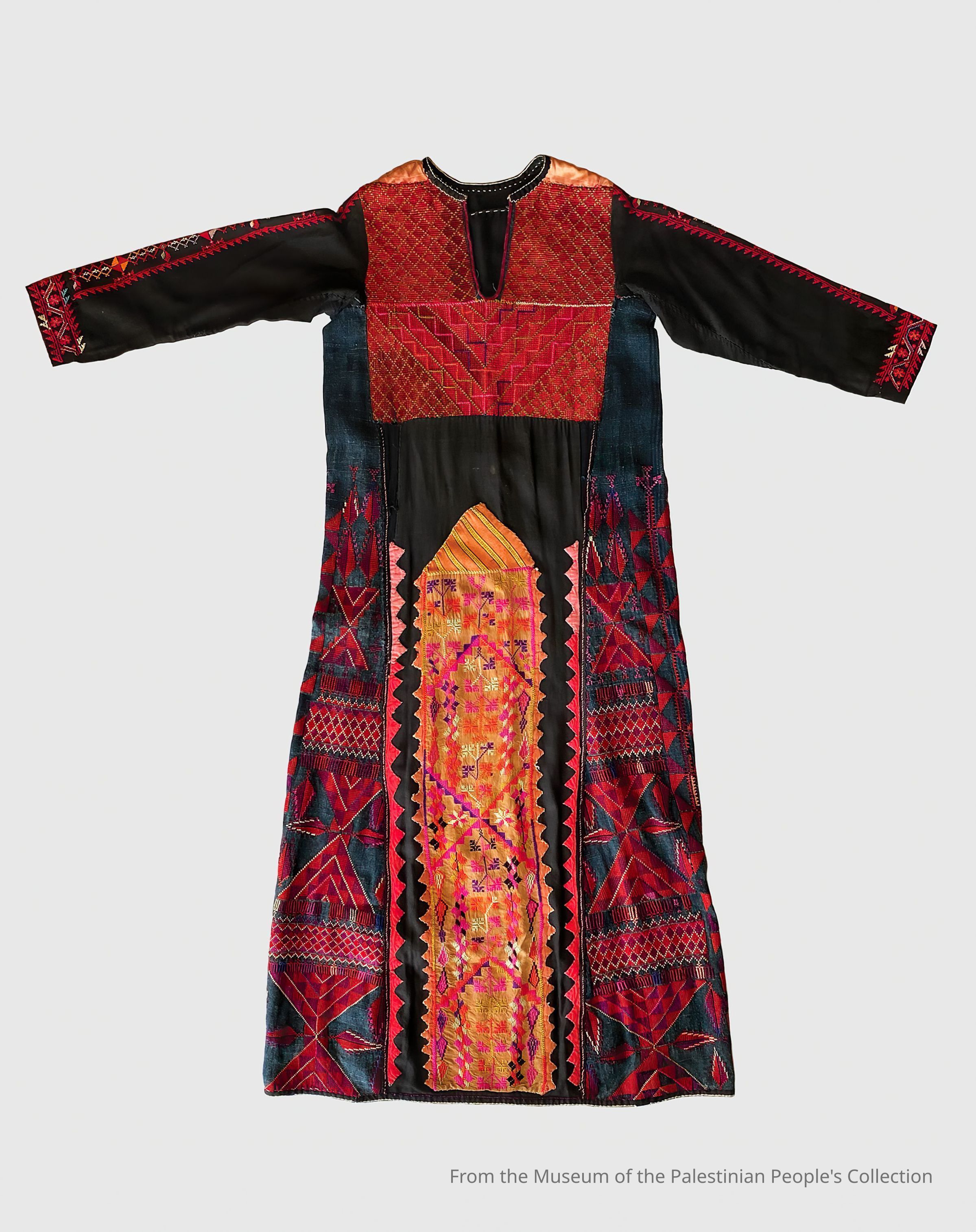
Photograph by Wafa Ghnaim

Photograph by Wafa Ghnaim

Name/Title

Gaza - Al Khalil Dress, Thobe (Early 20th Century)

Entry/Object ID

2022.020

Tags

Bayt wa Balad

Description

This dress (thobe) is from the villages between al-Khalil towards Gaza. The purple fabric was produced in al-Majdal, a weaving center for Palestinians prior to its depopulation in 1948-1950. It is attached with Managel Ghazawei, a binding stitch unique to the Gaza region. The yellow panel in the front center is made with taffeta, an overspun silk, delicate to touch, with a triangular top of striped Syrian silk. The embroidery is typical of Gaza, however the cut of the dress with the silk panel insert, is typical of al-Khalil styles. The dress incorporates patchwork of around four dresses, with the earliest dress from the (very) early twentieth century. Three of the four dresses that comprise this dress are from Gaza, and one is from Bir Saba, possibly indicating the exile of the wearer. Altogether, the dress is a beautiful showcase of multi-generational inheritance and adaptation, telling the story of a people in exile and dispossession, yet deep connection between generations of women. There are thirty-four distinct patches and fragments sewn into this garment, categorized in eight groupings, that contribute to the final determination of the dress’ origins. Examining each change in fabric and thread helps to construct a broader framework for understanding the garment’s migratory trajectory and the hands who contributed to its making. Not all thirty-four components bear regionally significant characteristics within the Palestinian context of identity and land; accordingly, they have been organized into eight groupings to support a more precise analysis that considers village identification, dating, as well as interpretation.

Cataloged By

Wafa Ghnaim

Category

Ethnographic Collection

Clothing/Dress/Costume Details

Article of Clothing/Dress/Costume

Dress

Clothing Sex

Female

Notes

Regarded as a vital component of Palestinian heritage.

Made/Created

Artist Information

Artist

Maker Once Known

Role

Maker

Time Period

20th Century

Place

Continent

Ethnography

Cultural Region

Continent

Relationships

Related Places

Notes

type: component-origin component: side skirt panels, benayek date: 19th c certainty: approximate notes: group 1 of 8

Notes

type: component-origin component: embroidered skirt panels, mawaris date: late-19th c certainty: approximate notes: group 2 of 8

Notes

type: component-origin component: lower back central panel, shinyar date: late-19th or early-20th c certainty: approximate notes: group 3 of 8

Notes

type: component-origin component: central silk panel, hijjer date: 1920s certainty: approximate notes: group 4 of 8

Notes

type: component-origin component: chest panel, qabbeh date: 1920s-1930s certainty: approximate notes: group 5 of 8

Notes

type: component-origin component: sleeves, kum date: 1940s-1950s certainty: approximate notes: group 6 of 8

Notes

type: component-origin component: al-Majdal jiljileh fabric date: 1950s-1960s certainty: approximate notes: group 7 of 8

Place

Continent

Notes

type: component-origin component: zigzag applique date: 1960s certainty: approximate notes: group 8 of 8

Notes

type: assembly date: mid-to-late nineteenth c certainty: approximate notes: The dress may have been assembled at different periods of the mid-to-late nineteenth century in unknown place(s), as it appears to have various sewing threads used throughout. In this case, "Palestinian Diaspora" is being used to indicate that this information is unknown.

Notes

type: travel date: 2011 certainty: precise notes: The components of the dress were already assembled when sold to Rochelle Davis. The dress was transported to Washington, DC with the donor.

Notes

type: travel date: 2021 certainty: precise notes: Rochelle Davis donated the object to the museum.

Provenance

Provenance Detail

Rochelle A. Davis

Notes

From Rochelle: "I think I got it in al-‘Arish in the Sinai on the border with Gaza. The indigo dyed cloth which is on parts of it is clearly pre-48." Donated in August 2021, catalogued in 2022 when CatalogIt was implemented.

General Notes

Note Type

BWB Export Variable

Note

Essay:BWBEssay.1